
Planning to buy a second-hand car in Delhi? Before checking prices, mileage and features, there is one important question you shouldn't ignore: Is the car legally allowed to run in Delhi-NCR?
Delhi has specific restrictions on older vehicles, emission standards and pollution-control compliance. Buying a car without understanding these rules can lead to unexpected problems, including penalties, restrictions on driving or even vehicle impounding.
Whether you're considering a petrol hatchback, diesel SUV or used family sedan, understanding the latest Delhi-NCR vehicle rules can help you make a smarter purchase.
Let's understand which cars are restricted, which vehicles you can consider and what to check before buying a used car in Delhi.
1. What Is the 10-Year Diesel and 15-Year Petrol Rule in Delhi?
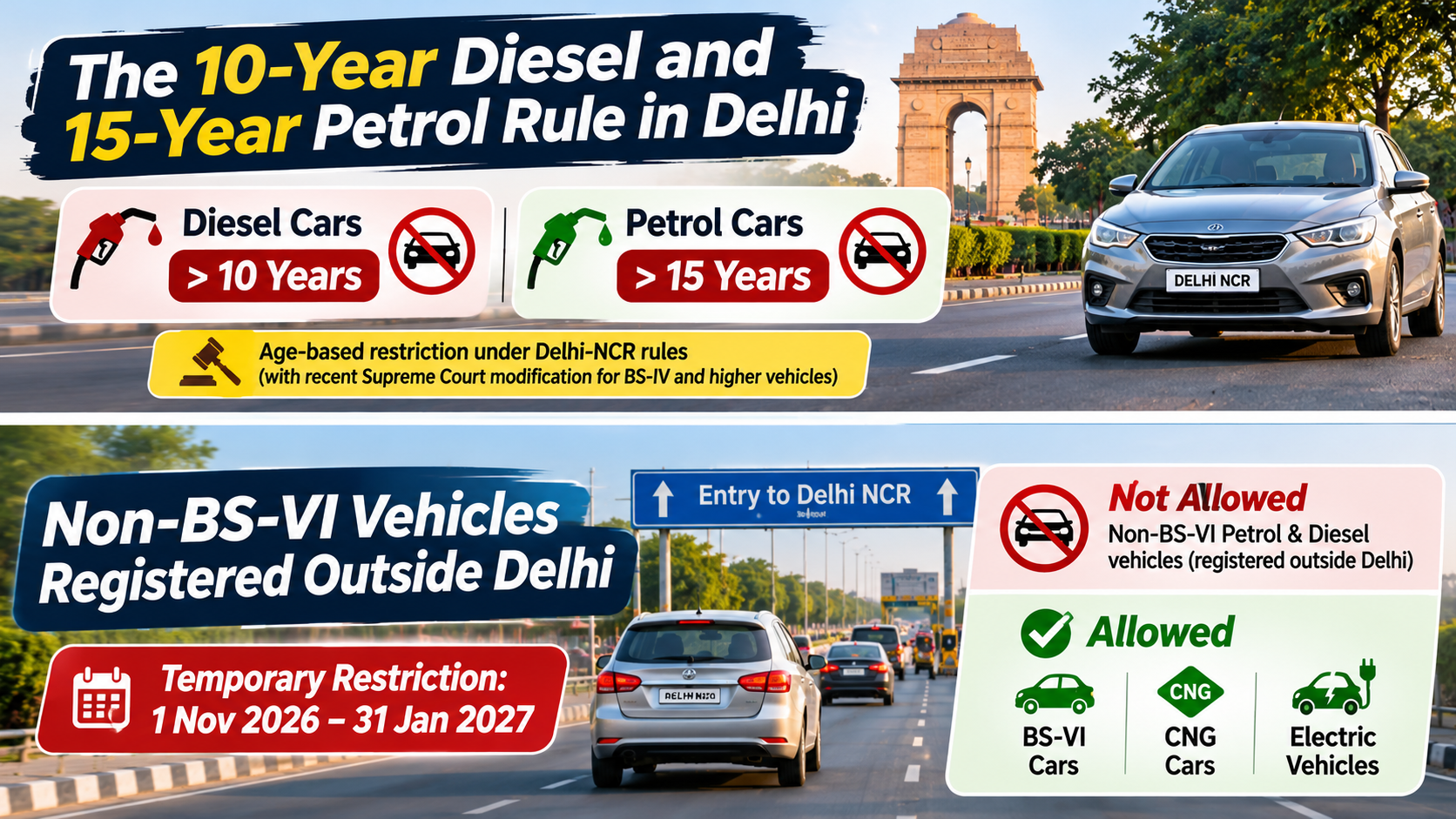
One of the most discussed vehicle regulations in Delhi-NCR is the 10-year diesel and 15-year petrol rule.
Under the established age-based restrictions:
- Diesel vehicles older than 10 years fall under the end-of-life vehicle restrictions.
- Petrol vehicles older than 15 years fall under the end-of-life vehicle restrictions.
These restrictions originated from directions of the National Green Tribunal and the Supreme Court in the M.C. Mehta case concerning air pollution in Delhi-NCR.
However, there is an important legal update that used-car buyers should know.
On 17 December 2025, the Supreme Court modified its earlier order concerning older vehicles. The Court clarified that BS-IV and higher emission-standard vehicles would be protected from coercive action under the age-based restriction. BS-III and older vehicles remain subject to enforcement, including impounding.
This means you should not assume that every diesel car older than 10 years or every petrol car older than 15 years automatically faces identical enforcement, irrespective of its emission standard.
Before purchasing an older vehicle, verify its registration date, emission category and current legal eligibility.
You can refer to the Delhi Transport Department's official end-of-life vehicle guidelines.
2. Which Cars Are Not Allowed in Delhi NCR?
Let's understand the main categories of vehicles that face restrictions.
A. Diesel Cars Older Than 10 Years
Diesel cars have historically faced stricter age restrictions in Delhi-NCR because of concerns about emissions from older diesel engines.
BS-III and older diesel vehicles exceeding the applicable 10-year age threshold remain subject to enforcement.
For BS-IV and newer diesel vehicles, the Supreme Court's December 2025 modification concerning coercive action must also be considered.
If you're purchasing a used diesel car, check:
- Original registration date.
- Bharat Stage emission standard.
- Registration Certificate (RC) status.
- Applicable vehicle restrictions.
- Insurance and pollution certificate validity.
B. Petrol Cars Older Than 15 Years
Petrol vehicles have an established age threshold of 15 years under the Delhi-NCR end-of-life vehicle framework.
However, BS-IV and higher vehicles have protection from coercive action under the age-based restriction following the Supreme Court's December 2025 modification.
Don't assume that a vehicle is automatically eligible for unrestricted use simply because it meets BS-IV or BS-VI standards. Other registration, documentation and pollution-control requirements still apply.
C. Non-BS-VI Vehicles Registered Outside Delhi: November 2026 Restrictions
There is another important update that Delhi commuters should understand.
From 1 November 2026, temporary winter pollution-control restrictions under the revised GRAP framework have introduced additional vehicle-entry restrictions.
Under the announced measures, non-BS-VI petrol and diesel vehicles registered outside Delhi face restrictions on entering the capital from 1 November 2026 to 31 January 2027, subject to applicable exemptions.
The permitted categories include:
- BS-VI-compliant vehicles.
- CNG vehicles.
- Electric vehicles.
- Vehicles covered by specified government exemptions.
Valid Pollution Under Control Certificates and other applicable requirements must also be considered.
For example, someone travelling from Gurugram or Noida to Delhi in an older non-BS-VI petrol or diesel car may face entry restrictions under these temporary measures.
These restrictions are different from the permanent age-based end-of-life vehicle framework.
Always check the latest Delhi Traffic Police vehicle-entry advisories before travelling.
D. Vehicles Without a Valid Pollution Certificate
Having a relatively new car doesn't mean you can ignore pollution-related documentation.
A valid Pollution Under Control Certificate (PUCC) is an important compliance requirement.
Delhi authorities have also introduced enforcement measures against vehicles without valid pollution certificates.
Before purchasing a second-hand car, check:
- PUCC validity.
- Registration Certificate.
- Vehicle emission standard.
- Insurance validity.
- Pending traffic challans.
3. Understanding BS3, BS4 and BS6 Vehicles
You may have seen terms like BS-III, BS-IV and BS-VI while searching for used cars.
But what do they actually mean?
BS stands for Bharat Stage. These are emission standards introduced to regulate pollutants released by motor vehicles.
Emission standard What it means BS-III Older emission standard BS-IV More stringent than BS-III BS-V Intermediate standard not generally implemented nationally BS-VI Stricter emission requirements
BS-VI vehicles generally have more advanced emission-control systems than older-generation vehicles.
For used-car buyers, checking the vehicle's actual emission standard is important because two cars manufactured in similar periods may have different specifications depending on their compliance and registration details.
Don't identify a vehicle's emission category using its model name alone. Verify the information through its RC, manufacturer documentation or official vehicle records.
4. Which Cars Can You Consider Buying in Delhi?
Now that we understand the restrictions, let's look at some popular used-car models that buyers can consider.
Remember, the eligibility of an individual vehicle depends on its registration, emission standard, current legal restrictions and documentation.
BS-VI Petrol Cars
BS-VI petrol cars are worth considering for buyers who want a relatively newer vehicle with modern emission technology.
Popular models include:
- Maruti Suzuki Swift.
- Maruti Suzuki Baleno.
- Hyundai Grand i10 Nios.
- Hyundai i20.
- Tata Altroz.
BS-VI Diesel Cars
BS-VI diesel cars can be an option for buyers who need a diesel-powered vehicle, particularly for longer journeys.
Some models worth exploring include:
- Hyundai Creta.
- Kia Seltos.
- Tata Nexon.
- Mahindra XUV300.
- Hyundai Venue.
CNG Cars
CNG vehicles can be practical for buyers who regularly commute within Delhi and want to manage their fuel expenses.
Popular models include:
- Maruti Suzuki WagonR CNG.
- Maruti Suzuki Celerio CNG.
- Maruti Suzuki Dzire CNG.
- Maruti Suzuki Baleno CNG.
- Hyundai Grand i10 Nios CNG.
For used CNG cars, check the RC endorsement, cylinder testing validity, fuel-system condition and maintenance history.
Electric Vehicles
Electric cars are another option for Delhi commuters.
Popular models in the used-car market include:
- Tata Nexon EV.
- Tata Tiago EV.
- MG ZS EV.
- Tata Tigor EV.
When purchasing a second-hand electric car, pay particular attention to battery health, charging performance, warranty status and service history.
5. What Should You Check Before Buying a Used Car in Delhi?
Imagine finding a used Hyundai Creta at an attractive price. The exterior looks excellent, the seller promises good performance and the price fits your budget.
But have you checked its registration date and emission standard?
A car may look perfect but still have compliance or documentation issues.
Before purchasing, follow this checklist.
- Check the original registration date
The registration date is important when determining the vehicle's age under applicable restrictions.
- Verify the BS emission standard
Check whether the vehicle is BS-III, BS-IV or BS-VI compliant. Don't rely only on the model year.
- Verify the RC
Check the registration certificate, ownership details, fuel type and any hypothecation information.
- Check PUCC validity
Make sure the vehicle has the required valid pollution certificate.
- Check insurance and challans
Verify insurance validity and any pending traffic challans.
- Inspect the vehicle's condition
Check the engine, transmission, suspension, tyres, electrical systems and accident history.
- Check transfer eligibility
Before paying the seller, verify that the vehicle can legally be transferred and registered for your intended use.
For a more detailed inspection process, read our complete guide to buying verified used cars in Delhi NCR.
6. How to Find the Right Used Car in Delhi Without Taking Unnecessary Risks
Buying a used car isn't just about finding the lowest price.
You need to consider the vehicle's condition, registration eligibility, maintenance expenses and whether it suits your everyday requirements.
For example, someone commuting from Dwarka to Gurgaon may prefer a comfortable petrol car, while someone travelling longer distances every day might consider a suitable diesel or CNG vehicle.
The important thing is to select a car based on your actual requirements rather than making a decision simply because a seller offers an attractive price.
At Hooter, we believe the used-car buying experience should be built around transparency and trust.
Why Consider Hooter?
Transparency comes first
We believe buyers should receive clear and relevant information about the vehicles they are considering.
Verified listings and vehicle information
Hooter brings together verified dealer listings and direct-owner listings, helping buyers understand who they are dealing with before making a decision.
Find a car that matches your requirements
Whether you are looking for a hatchback, sedan or SUV, you can compare available options by budget, brand, fuel type, transmission and other vehicle details.
A relationship beyond the transaction
We don't believe the relationship should end after a customer purchases a car. We want to build long-term relationships based on trust, honest information and a better buying experience.
7. Explore Used Cars in Delhi with Hooter
Now that you understand Delhi-NCR's vehicle restrictions, the next step is finding a car that matches your budget, requirements and applicable legal eligibility.
Don't purchase a vehicle simply because it looks affordable. Check its registration, emission standard, documents and mechanical condition before making a decision.
If you're searching for your next car, explore the best used cars in Delhi on Hooter.
You can also browse available used cars on Hooter to compare different brands, models, prices and vehicle specifications.
If you're still researching the buying process, read our complete guide to buying a used car in Delhi.
At Hooter, we believe buying a used car should be a confident decision, not a guessing game.
We're not just interested in selling cars. We want to build relationships with customers through transparency, trust and value.
Frequently Asked Questions
1. Which cars are banned in Delhi NCR?
Delhi-NCR has restrictions on end-of-life vehicles, including older diesel and petrol vehicles. The applicable age-based restrictions must be read along with the Supreme Court's December 2025 modification protecting BS-IV and higher vehicles from coercive action under the age-based rule. Temporary pollution-control restrictions may also apply.
2. Are 10-year-old diesel cars banned in Delhi?
The 10-year diesel age threshold remains part of the end-of-life vehicle framework. However, the Supreme Court's December 2025 modification provides protection from coercive action under the age-based restriction for BS-IV and higher vehicles. BS-III and older vehicles remain subject to enforcement.
3. Are 15-year-old petrol cars allowed in Delhi?
The 15-year petrol age threshold applies under the established framework. However, BS-IV and higher vehicles have protection from coercive action under the age-based restriction following the Supreme Court's December 2025 modification. Other applicable legal requirements still apply.
4. Are BS6 cars allowed in Delhi?
BS-VI vehicles are among the permitted categories under the temporary November 2026 entry restrictions, subject to valid documentation and other applicable rules.
5. Can I drive a BS4 diesel car in Delhi?
The Supreme Court's December 2025 modification protects BS-IV and higher vehicles from coercive action under the age-based restriction. However, separate pollution-control restrictions, registration requirements and other applicable rules must still be checked.
6. Can I buy a 12-year-old petrol car in Delhi?
A 12-year-old petrol car may be eligible under the applicable age-based rules, depending on its emission standard and registration status. Check the specific vehicle's documentation and legal eligibility before purchasing.
7. Are CNG cars allowed in Delhi?
CNG vehicles are among the permitted categories under the temporary winter entry restrictions, subject to applicable documentation and exemptions. Their registration, pollution compliance and other legal requirements must still be valid.
8. How can I check whether my car is banned in Delhi?
Check the vehicle's registration date, fuel type, emission standard and RC status. You can also verify relevant vehicle information through the Parivahan portal and check the latest notifications issued by Delhi authorities.
9. Is it safe to buy a second-hand diesel car in Delhi?
It can be, provided the vehicle meets the applicable emission, registration and legal requirements. Check its age, emission category, service history and current eligibility before purchasing.
10. Where can I find used cars that are suitable for Delhi driving?
You can explore used cars in Delhi on Hooter. Compare the vehicle details, check its documentation and condition, and confirm its legal eligibility before finalising a purchase.