
Searching for used cars for sale in India can feel exciting and confusing at the same time. You may find hundreds of listings in your budget, from 3-year-old hatchbacks to older SUVs with premium features. But the right used car is not simply the cheapest one. It is the car that fits your daily use, has clean documents, is priced fairly, and will not surprise you with heavy repair bills after purchase.
For Indian buyers, this decision is especially important because ownership costs vary widely by city, fuel type, road conditions, insurance history, and registration rules. A car that looks like a great deal in photos may become expensive if it has pending challans, unpaid loans, flood damage, mismatched tyres, or a poor service record.
This guide will help you shortlist smarter, compare prices properly, inspect with confidence, and buy a used car online or through a dealer with better peace of mind.
Start With the Car You Actually Need
Before comparing listings, define the job your car must do. Many buyers get tempted by a bigger car, higher variant, or luxury badge, but the best used car is usually the one that matches your real driving pattern.
If most of your driving is in crowded city traffic, a compact hatchback or automatic petrol car may be easier to live with than a large SUV. If you regularly travel with family, rear-seat comfort, boot space, AC performance, and safety should matter more than alloy wheels or a sunroof. If you drive long highway distances, stability, braking, service history, tyre condition, and fuel efficiency become more important.
| Buyer need | Better used-car direction | What to prioritise |
|---|---|---|
| Daily city commute | Hatchback, compact sedan, compact SUV | Easy parking, mileage, light steering, service cost |
| Small family use | Premium hatchback, compact sedan, compact SUV | Rear seat comfort, boot space, safety features |
| Highway running | Sedan, SUV, well-maintained diesel or petrol | Brakes, tyres, engine health, stability |
| Rough roads or semi-urban use | Compact SUV, high-ground-clearance hatchback | Suspension, underbody condition, ground clearance |
| Low running cost | Petrol CNG, efficient petrol, EV if charging is available | Fuel cost, service history, battery or CNG checks |
A clear use case prevents overspending. For example, a used 7-seater may look like a value deal, but it may not be ideal if you drive alone in city traffic every day. Similarly, a premium used sedan may offer comfort, but service and spare costs may be higher than a mass-market hatchback.
Set a Realistic Budget, Not Just a Purchase Price
The price shown in a listing is only one part of the total cost. When buying a used car in India, keep a separate buffer for transfer, insurance, repairs, tyres, servicing, and possible accessories. A car priced at ₹5 lakh can easily require ₹40,000 to ₹80,000 more if insurance renewal, tyres, battery, suspension work, or major service is due.
A practical approach is to keep 10% to 15% of your car budget aside for immediate post-purchase expenses. If your maximum budget is ₹6 lakh, try shortlisting cars around ₹5.25 lakh to ₹5.50 lakh so you still have room for repairs and paperwork.
| Cost head | Why it matters |
|---|---|
| Insurance | Policy may be expiring, third-party only, or missing useful add-ons |
| RC transfer | Ownership must be legally transferred after purchase |
| Immediate service | Oil, filters, brake pads, fluids, wheel alignment may be needed |
| Tyres and battery | Old tyres or weak battery can add a big instant expense |
| Loan and paperwork | Hypothecation removal or bank NOC delays can affect transfer |
If you are taking a loan, compare the EMI with your monthly running costs. Fuel, parking, tolls, maintenance, washing, and insurance can make a low EMI feel heavy over time.
Choose the Right Age and Mileage Sweet Spot
There is no single perfect mileage for a used car. A well-maintained car with 70,000 km can be better than a neglected car with 30,000 km. Still, age and mileage help you understand expected wear.
For many Indian buyers, cars between 2 and 6 years old offer a good balance of price, features, and reliability. They have already taken a major depreciation hit, but may still have modern safety features, better fuel efficiency, and available service support. Older cars can be good value too, especially for tight budgets, but they need deeper inspection.
Do not judge mileage alone. Look at the pattern:
- Low mileage with poor service history can indicate neglect.
- High mileage with complete service records may indicate regular highway use and responsible ownership.
- Very low mileage on an old car may mean long periods of non-use, which can affect tyres, battery, fluids, and seals.
- Odometer readings that do not match tyre wear, seat wear, pedal wear, or service records are a red flag.
Also check local registration rules. Some regions have stricter age limits for older petrol and diesel vehicles. Before buying an older car, verify whether it can be legally driven and transferred in your city or state through the local RTO or official portals such as Parivahan.
Compare Prices Like a Buyer, Not a Bargain Hunter
The lowest price is not always the best deal. Used car prices depend on variant, city, ownership count, accident history, insurance validity, colour demand, fuel type, tyre age, service record, and dealer support.
Two cars of the same model year can have very different values. A single-owner car with dealer service history, valid comprehensive insurance, new tyres, and clean documents deserves a premium. A cheaper car with repainting, missing service records, expiring insurance, or pending loan closure may cost more after purchase.
Use a marketplace like Hooter to compare used cars across brands, body types, and budgets in one place. Hooter helps buyers discover verified dealer listings, compare prices, and access expert guidance, which is useful when you are trying to understand whether a listing is genuinely fair or just attractively priced.
Here is a simple price-quality scorecard you can use while shortlisting:
| Factor | Good sign | Caution sign |
|---|---|---|
| Ownership | First or second owner | Multiple owners in a short time |
| Service history | Complete records, regular intervals | Missing bills, vague claims |
| Insurance | Valid comprehensive policy | Expired policy or only basic cover |
| Condition | Original panels, even paint, clean cabin | Patchy paint, rust, damp smell |
| Price | Close to market value | Too low without a clear reason |
If a car is priced much lower than similar listings, ask why. Genuine reasons may include urgent sale, high mileage, older model year, or cosmetic issues. Risky reasons may include accident damage, flood exposure, loan disputes, or document problems.
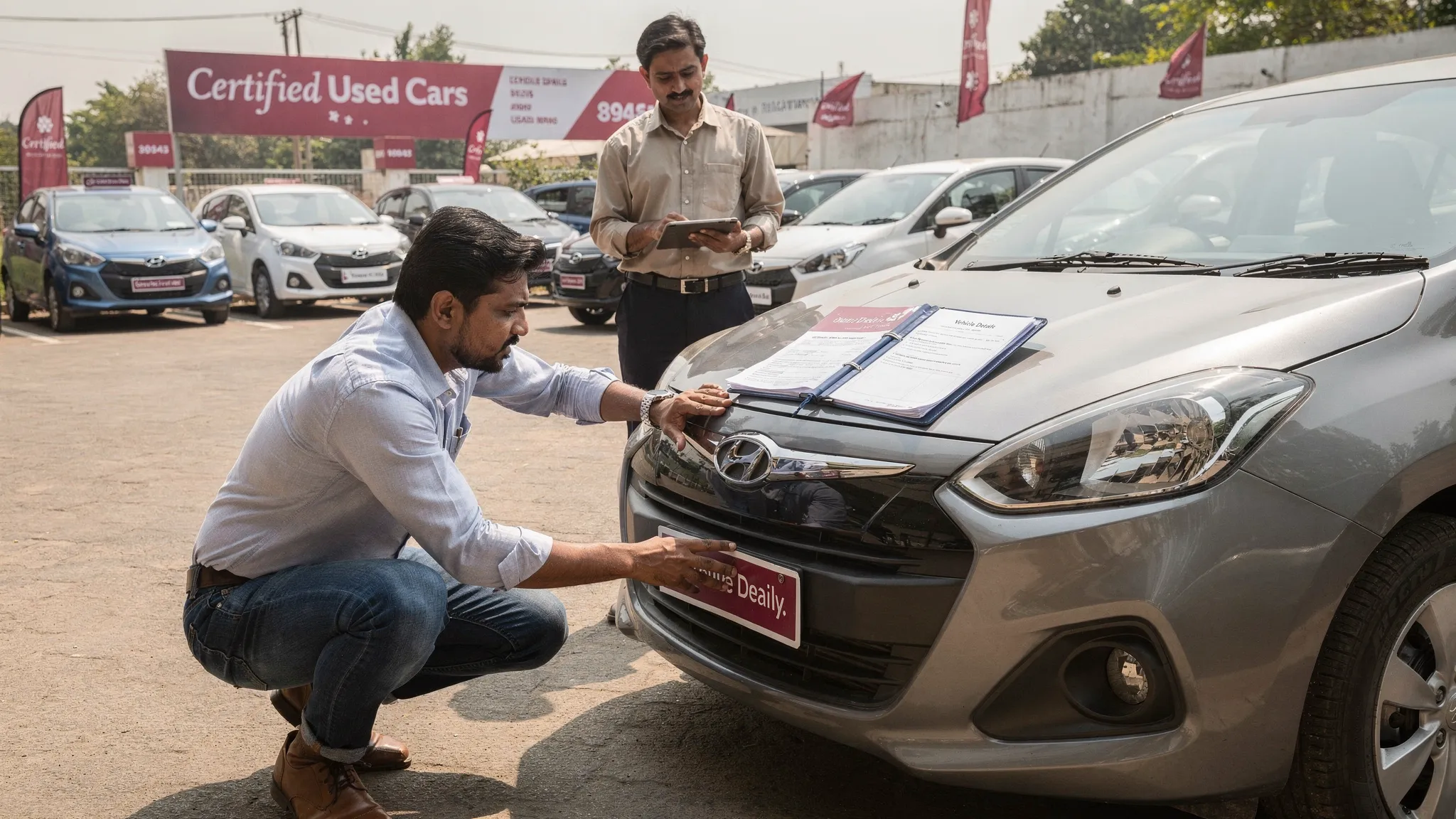
Decide Where to Buy: Online Marketplace, Dealer, or Individual Seller
India has three common used-car buying routes. Each can work well if you know what to check.
| Buying route | Advantages | What to watch out for |
|---|---|---|
| Online marketplace | Wider choice, easier comparison, filters by budget or body type | Still verify documents, inspection, and final payment terms |
| Verified dealer | More structured process, easier paperwork support, multiple cars at one place | Compare pricing and clarify all charges in writing |
| Individual seller | Possible lower price, direct history from owner | Higher responsibility for document checks and transfer |
For most buyers, especially first-time used-car buyers, a trusted platform with verified dealer listings can reduce the stress of discovery and comparison. It does not remove the need for inspection, but it makes the search more organised.
If you are using Hooter, start by filtering by budget, brand, body type, and fuel type. Then shortlist cars that have clear photos, sensible pricing, and complete seller information. Avoid rushing to visit every listing. A focused shortlist saves time and gives you better negotiation power.
Inspect the Listing Before You Visit
A good used-car decision starts before the physical inspection. Study the listing carefully and ask for basic information in advance. This helps you avoid wasted visits and filters out weak listings early.
Ask for clear photos of the exterior, interior, odometer, tyres, engine bay, RC, insurance, and service records. Check whether the variant mentioned in the listing matches the features shown in the photos. For example, airbags, infotainment system, alloy wheels, sunroof, rear camera, and automatic transmission should match the stated variant.
Before visiting, confirm these details:
- Exact model year and registration year
- Variant, fuel type, and transmission
- Number of owners
- Odometer reading
- Insurance validity and claim history if available
- Service record availability
- Loan status and hypothecation status
- Reason for sale
If the seller avoids basic questions, pushes for an advance payment, or refuses to share documents for verification, move on.
For a deeper safety checklist, you can also read Hooter’s guide on top things to check before buying a used car.
Do a Physical Inspection With a Cold Start
Always inspect the car in daylight, preferably when the engine is cold. A warm engine can hide starting issues, smoke, weak battery symptoms, or abnormal noises.
Start with the exterior. Look for uneven panel gaps, colour mismatch, overspray near rubber seals, rust around the doors, and signs of repainting. Minor scratches are normal in a used car, but structural damage is not. Check the windshield, lights, bumper mounts, and underbody where possible.
Inside the cabin, check seat wear, steering wear, roof lining, AC cooling, infotainment, power windows, central locking, wipers, horn, reverse camera, and warning lights. A damp smell, water marks under carpets, or rust near seat rails may indicate flood exposure.
Under the hood, look for oil leaks, coolant leaks, worn belts, corroded battery terminals, and unusual engine vibrations. Do not expect the engine bay to look brand new, but avoid cars that show fresh cleaning only in certain areas, as it may be used to hide leaks.
If you are not confident, take a trusted mechanic or request an independent pre-purchase inspection. The inspection cost is small compared to the cost of buying a problematic car.
Take a Proper Test Drive
A test drive should cover more than a short round near the dealer. Drive on broken roads, open stretches, speed breakers, and traffic if possible. Keep the music system off so you can hear the car.
During the drive, notice how the car starts, idles, accelerates, brakes, steers, and shifts gears. The clutch should not feel excessively hard or slip under acceleration. Automatic gearboxes should shift smoothly without jerks or delays. The car should not pull to one side under braking or driving.
Pay attention to suspension noises, steering vibration, engine warning lights, brake feel, AC cooling at idle, and tyre noise. If the seller refuses a reasonable test drive, treat it as a warning sign.
Safety should also be part of the decision. Prefer cars with dual airbags, ABS, electronic stability control, ISOFIX if you have children, and a strong crash safety reputation. You can refer to official safety information from Bharat NCAP when comparing newer models that have been tested.
Verify Documents Before Any Payment
Clean paperwork is as important as mechanical condition. A used car should not be purchased only on trust, even from a friendly seller. Verify all documents and ensure the details match the car.
| Document or check | Why it matters | Red flag |
|---|---|---|
| RC | Confirms registration, owner, fuel type, engine and chassis details | Name mismatch, duplicate RC without explanation |
| Insurance | Shows active cover and policy type | Expired policy, major claim history not disclosed |
| PUC certificate | Required for legal road use | Missing or expired PUC |
| Form 29 and Form 30 | Used for ownership transfer | Seller delays signing transfer forms |
| Bank NOC | Needed if the car had a loan | Hypothecation still active |
| Service history | Confirms maintenance pattern | No bills, inconsistent odometer entries |
| Challan check | Ensures no pending traffic fines | Seller refuses to clear dues |
Use the official eChallan portal to check pending challans where available. You can also use Parivahan-related services to cross-check vehicle details. Make sure the chassis number and engine number on the car match the RC.
If the car is still under loan, do not make full payment until loan closure and NOC status are clear. If buying from a dealer, ask who will handle RC transfer, how long it will take, and what written proof you will receive.
Pick the Right Fuel Type for Your Use
Fuel type can make or break your ownership experience. Do not choose diesel, CNG, or EV only because the running cost looks attractive. Match it with your usage and city conditions.
| Fuel type | Best for | Key used-car checks |
|---|---|---|
| Petrol | City driving, lower annual running, easier maintenance | Mileage, service record, clutch, AC, engine smoothness |
| Diesel | High monthly running, highway use, torque needs | Emission rules, injector health, turbo, DPF if applicable |
| CNG | High city running and low fuel cost | RC endorsement, kit quality, cylinder validity, boot space |
| EV | Home charging access, city use, low running cost | Battery health, charger, warranty transfer, range consistency |
| Hybrid | City efficiency with petrol convenience | Service history, hybrid battery condition, authorised service support |
For most low-to-medium usage buyers, petrol is still the simplest used-car choice. Diesel makes more sense if your monthly running is high and local rules allow long-term use. CNG is practical for city running if the kit is factory-fitted or properly endorsed. Used EVs can be attractive, but battery condition, charging access, and warranty status are critical.
Negotiate Based on Facts
Negotiation works best when you have evidence. Do not simply ask for the last price. Compare similar listings, note upcoming expenses, and use inspection findings to discuss a fair reduction.
Common negotiation points include worn tyres, expired insurance, weak battery, pending service, repainting, missing spare key, non-functional features, or incomplete service records. Keep the tone practical. A seller is more likely to respond to clear cost-based points than random bargaining.
Before final payment, get these points in writing:
- Final sale price
- Included charges and excluded charges
- RC transfer responsibility
- Insurance transfer or renewal plan
- Delivery date and condition
- Payment mode and receipt
- Any promised repair or accessory
Avoid cash-heavy deals without records. Use traceable payment methods and collect a proper receipt. Do not pay the full amount until documents, transfer forms, and vehicle handover terms are clear.
For online buying safety, Hooter’s guide on how to buy a car online safely in India is a useful next read.
Common Mistakes to Avoid
Many used-car problems happen because buyers rush after finding an attractive listing. Slow down before you commit.
Avoid buying only because the car is cheap. Avoid skipping a test drive. Avoid ignoring missing service records. Avoid paying a token amount before verifying the seller. Avoid assuming the dealer will automatically handle everything unless it is written. Avoid buying a diesel car without checking local age rules. Avoid emotional decisions based on colour, sunroof, or premium badge.
The best used-car buyers are patient. They compare, inspect, verify, and then negotiate.
Frequently Asked Questions
What is the best way to find used cars for sale in India? The best way is to use a trusted online marketplace, compare similar cars by model, year, mileage, variant, and condition, then verify documents and inspect the car before payment. Platforms like Hooter help you browse verified dealer listings and compare options across budgets.
How many kilometres is acceptable for a used car? There is no fixed number. A well-maintained car with 60,000 to 80,000 km can be a better buy than a poorly maintained car with 30,000 km. Service history, ownership pattern, and condition matter more than mileage alone.
Should I buy a used car from a dealer or an individual seller? A verified dealer may offer a more structured process and easier comparison, while an individual seller may offer a lower price. In both cases, inspect the car, verify documents, check challans, and ensure RC transfer is completed.
Which documents should I check before buying a used car in India? Check RC, insurance, PUC, service records, Form 29 and Form 30, bank NOC if the car had a loan, and pending challans. Match the engine and chassis numbers with the RC before making full payment.
Is it safe to buy a used car online in India? Yes, it can be safe if you use a trusted platform, avoid unverified sellers, inspect the car physically, verify documents, use traceable payments, and complete RC transfer properly. Never pay a large advance only based on photos.
Find the Right Used Car With Hooter
The right used car should fit your budget, lifestyle, and long-term ownership comfort. Hooter makes the search easier by bringing verified used car listings, car price comparison, expert insights, transparent services, and insurance support into one marketplace.
Whether you are looking for a budget hatchback, a family sedan, a compact SUV, or a second-hand car from a trusted dealer, start by comparing options on Hooter. Shortlist carefully, inspect confidently, and buy your next car with complete peace of mind.