
Buying a car online in India is convenient, fast, and often better for comparison than visiting multiple showrooms or used car markets. You can filter by budget, brand, fuel type, body style, mileage, ownership history, and location before you ever speak to a seller. But convenience should not replace caution.
The safest way to buy a car online is to treat the internet as your research and shortlisting tool, then complete verification, inspection, payment, and transfer with the same discipline you would use in a physical purchase. Whether you are buying your first hatchback, upgrading to an SUV, or looking for a verified used car, this guide will help you avoid common mistakes and make a confident decision.
Why online car buying needs extra care in India
India has a large and growing used car market, and many genuine dealers and sellers now list vehicles online. That is good news for buyers because it increases choice and makes price comparison easier. The challenge is that online listings can also hide problems if you rely only on photos, low prices, or verbal promises.
Common risks include mismatched vehicle documents, unpaid loans, pending challans, accident or flood-damaged cars, odometer tampering, fake urgency, and unsafe payment requests. None of these risks mean you should avoid buying online. They simply mean you need a proper process.
A safe online car purchase has four pillars: a trusted platform, complete document verification, a proper inspection or test drive, and traceable payment with correct ownership transfer.
Start with a trusted online car platform
The platform you choose affects the quality of your shortlist. A good online car marketplace should make it easier to compare vehicles, understand pricing, and connect with genuine sellers or dealers.
Look for platforms that provide clear listing details, verified dealer information, transparent pricing, multiple photos, expert guidance, and enough filters to compare cars by budget, brand, body type, fuel type, and location. If the listing feels vague or the seller avoids basic questions, move on.
On Hooter, buyers can browse verified used car listings from trusted dealers, compare prices across brands and budgets, and access expert guidance in one place. This does not remove the need for your own checks, but it gives you a more organised and transparent starting point than random classifieds or unverified social media posts.
Fix your budget before you shortlist cars
When buying online, it is easy to stretch your budget because better-looking options appear just a few clicks away. Decide your maximum budget before you start contacting sellers. For a used car, your budget should not be only the listing price. It should include the total cost of making the car road-ready in your name.
| Cost to include | Why it matters |
|---|---|
| Car purchase price | The listed price is the starting point for negotiation |
| Insurance | A valid policy is legally necessary before driving |
| RC transfer and RTO costs | Ownership must be transferred properly after purchase |
| Immediate service | Used cars may need oil, filters, fluids, or brake work |
| Tyres and battery | These are common replacement costs in older cars |
| Pending challans or taxes | These should ideally be cleared before purchase |
| Loan processing charges | Relevant if you are financing the car |
| Accessories or repairs | Avoid overspending on non-essential add-ons |
As a rule, keep a buffer for immediate maintenance. A slightly more expensive car with clean documents and service history can be better value than a cheaper car with hidden repair costs.
Verify the listing before you visit or pay anything
Before you schedule a test drive, ask for important details in writing. Keep screenshots of the listing, chat, price quote, and any promises made by the seller or dealer. This helps avoid confusion later.
Check the exact model, variant, registration year, manufacturing year, fuel type, transmission, ownership count, odometer reading, insurance validity, service history, and location of the car. Also ask whether the car has any active loan or hypothecation.
The registration number is especially important. You can use the government’s Parivahan portal to check basic vehicle registration details where available. For pending traffic fines, use the eChallan portal. These checks are not a replacement for original document verification, but they help you catch obvious mismatches early.
| Detail to verify | What to check | Red flag |
|---|---|---|
| Registration number | State, RTO, fuel type, vehicle class | Seller refuses to share it before inspection |
| Chassis and engine number | Must match RC and physical vehicle | Scratched, altered, or mismatched numbers |
| Variant | Features, airbags, transmission, infotainment | Listing claims a higher variant without proof |
| Odometer reading | Compare with service records | Sudden mileage gaps or inconsistent records |
| Ownership count | First owner, second owner, or beyond | Seller hides previous ownership |
| Insurance | Active policy, claim history if available | Expired policy or frequent claims |
| Loan status | Hypothecation, bank NOC, Form 35 if applicable | Active loan without closure documents |
Check the car documents carefully
Documents are the backbone of a safe car purchase. Do not accept excuses like paperwork will be done later or original documents are not available today. For an online car deal, document verification should happen before you make a major payment.
You can ask for clear digital copies first, but verify originals before final payment. Digital documents stored in DigiLocker or official apps can also help confirm authenticity, where applicable.
For a used car in India, check these documents carefully:
| Document | Why it is important | What to look for |
|---|---|---|
| Registration Certificate (RC) | Proves registration and ownership details | Owner name, engine number, chassis number, fuel type, hypothecation |
| Insurance policy | Confirms the car is insured | Policy validity, vehicle number, owner details, coverage type |
| PUC certificate | Required for pollution compliance | Validity date and correct registration number |
| Service records | Shows maintenance and mileage pattern | Regular service, major repairs, odometer consistency |
| Form 29 and Form 30 | Used for ownership transfer | Correct buyer and seller details before submission |
| Bank NOC and Form 35 | Needed if loan hypothecation is removed | Bank stamp, closure proof, matching vehicle details |
| Seller ID and address proof | Confirms seller identity | Details matching RC or dealer invoice |
| Road tax and fitness records | Important for commercial or transferred vehicles | Avoid cars with unclear commercial history |
| Challan status | Pending fines can create issues | Ask seller to clear dues before transfer |
If the vehicle is from another state, ask about the NOC from the original RTO and estimate re-registration or tax costs in your state. Interstate transfers can take more time and may involve extra paperwork.
Inspect the car before finalising the deal
Photos can hide dents, repainting, rust, tyre wear, flood damage, and poor repairs. Even high-quality online listings should be followed by a physical inspection or a trusted third-party inspection.
If you are not mechanically confident, take a mechanic or choose a dealer/platform that can support inspection guidance. A professional eye can identify accident repairs, oil leaks, suspension issues, clutch wear, electrical faults, and signs of odometer tampering.
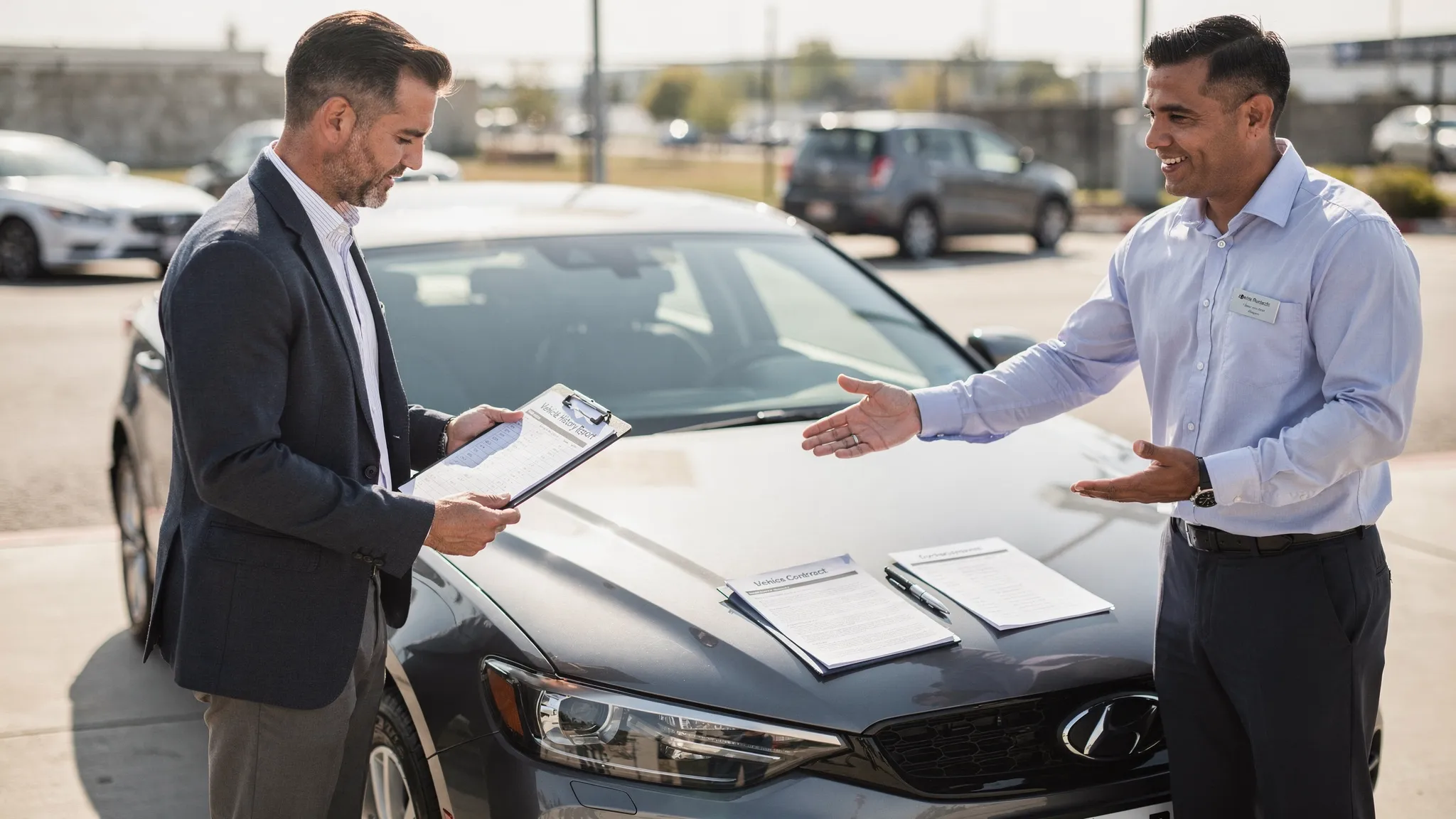
During inspection, pay attention to the exterior, interior, engine bay, tyres, underbody, electronics, AC, steering, brakes, suspension, and dashboard warning lights. Ask for a cold start because some engine problems are easier to notice when the car has not been warmed up.
Flood-damaged cars need special caution. Check for musty smells, water stains under carpets, rust on seat rails, foggy lamps, malfunctioning electronics, and mud marks in hidden areas. For accident damage, look for uneven panel gaps, fresh paint mismatch, overspray, replaced glass, welding marks, and unusual tyre wear.
Never skip the test drive
Even if you are comfortable buying a car online, do not skip the test drive unless you are purchasing from a highly structured process with reliable inspection support. A test drive helps you understand comfort, visibility, steering feel, braking, clutch or gearbox behaviour, suspension noise, engine response, and overall confidence.
Meet at a safe location, preferably the dealer office, seller’s registered address, or a public place during daylight. Carry your driving licence. Confirm that the car has valid insurance before driving. Avoid isolated locations and do not go alone if you are meeting a private seller for the first time.
Drive on a mix of roads if possible. In city traffic, check clutch smoothness, steering weight, AC cooling, and engine temperature. On open roads, observe acceleration, braking stability, vibrations, alignment, and cabin noise. For automatic cars, gear shifts should be smooth without jerks or delays. For manual cars, the clutch should not feel excessively hard or slip under acceleration.
Compare the price with similar cars
A safe deal is not always the cheapest deal. The right price depends on the model, variant, registration year, kilometres driven, ownership count, fuel type, service history, accident history, insurance validity, tyre condition, and demand in your city.
Use online car price comparison before negotiating. Compare the car only with similar listings. For example, a first-owner petrol automatic SUV with full service history should not be priced the same as a third-owner diesel manual with patchy records.
Hooter’s car price comparison and marketplace browsing can help you understand whether a listed price is realistic across different brands and budgets. Once you know the market range, negotiate based on facts such as upcoming service, tyre wear, insurance renewal, scratches, or missing accessories.
Pay safely and keep every transaction traceable
Payment is where many online car scams happen. A genuine seller should be comfortable with written receipts, traceable payments, and document-based verification. Be careful if someone pressures you to pay quickly, offers an unbelievable discount, or asks you to transfer money to an unrelated account.
For booking or token payments, keep the amount reasonable and insist on a written receipt. The receipt should mention the vehicle registration number, chassis number if available, buyer and seller details, amount paid, date, final agreed price, refund terms, and expected delivery or transfer timeline.
Avoid paying the full amount before document verification, inspection, and a signed sale agreement. Use bank transfer, cheque, demand draft, or another traceable method. Avoid large cash payments because they create proof and compliance issues. If you are buying from a dealer, ask for a proper invoice or receipt with business details where applicable.
Never share OTPs, UPI PINs, net banking passwords, Aadhaar OTPs, or card details with anyone. Also be cautious of fake stories involving army personnel, airport customs vehicles, urgent relocation, seized cars, or a seller who claims they cannot meet but needs an advance immediately.
Complete RC transfer and insurance correctly
For used cars, the deal is not complete when you receive the keys. Ownership must be transferred in the Regional Transport Office records. Until the transfer is completed, both buyer and seller can face complications if there is an accident, challan, insurance claim, or legal dispute.
The usual transfer process involves Form 29, Form 30, original RC, insurance, PUC, buyer and seller ID/address proof, and additional documents if the car has loan hypothecation or is moving between states. Many RTO services can be initiated through Parivahan, but requirements can vary by state and RTO.
Ask the seller to clear pending challans before transfer. If the car had a loan, ensure the bank NOC and Form 35 are available before making full payment. If the car is registered in another state, confirm the NOC and understand local re-registration costs.
Insurance also needs attention. Inform the insurer about the ownership change and get the policy transferred or renewed in your name as required. Third-party coverage and own-damage coverage rules can differ in practical handling, so confirm the process with the insurance provider before driving regularly.
Also update or check FASTag, service records, warranty transfer if applicable, extended warranty, RSA packages, and any connected-car subscription linked to the previous owner.
Delivery day checklist
Before you take delivery, slow down and check everything again. Many buyers become relaxed once the price is agreed, but delivery day is when you should be most detail-oriented.
| Before final handover | What to confirm |
|---|---|
| Vehicle identity | Registration number, VIN/chassis number, engine number match documents |
| Payment proof | Receipts, invoice, sale agreement, bank transfer record |
| Keys | Two keys if available, remote functioning, spare key condition |
| Documents | RC copy, insurance, PUC, service history, transfer forms |
| Physical condition | Same condition as inspected, no new damage |
| Accessories | Spare tyre, jack, toolkit, manual, floor mats, infotainment card if any |
| Warning lights | No engine, ABS, airbag, or battery warning after start |
| Fuel and odometer | Note reading at delivery time |
| Transfer timeline | Written commitment for RC transfer steps if dealer-assisted |
Take photos or videos of the car at delivery, including odometer, exterior condition, and document handover. This creates a useful record for both buyer and seller.
Common red flags when buying a car online
Some warning signs should make you pause immediately. A genuine seller may have incomplete information at first, but they should not avoid verification.
| Red flag | What you should do |
|---|---|
| Price is far below market value | Compare similar cars and ask why it is so low |
| Seller demands urgent advance | Do not pay until documents and identity are verified |
| Registration number is hidden throughout | Avoid the deal unless there is a valid reason and later verification |
| RC owner and seller are different | Ask for authorisation or dealer purchase proof |
| Chassis number does not match RC | Walk away from the deal |
| Loan hypothecation exists without NOC | Do not make full payment |
| Seller refuses inspection or test drive | Treat it as a major warning sign |
| Payment account name is unrelated | Do not transfer money without written explanation and proof |
| Odometer and service records do not align | Get expert inspection or avoid the car |
| Pending challans are ignored | Ask seller to clear them before transfer |
New car vs used car: safety differences when buying online
If you are buying a new car online, the main checks are dealer authenticity, final on-road price, insurance quote, variant confirmation, manufacturing month, delivery timeline, registration process, and invoice accuracy. Make sure the VIN, colour, variant, and accessories match what you booked.
If you are buying a used car online, the checks are broader because the car has a history. You need to verify ownership, service records, accident signs, loan status, challans, insurance, odometer consistency, and transfer paperwork. Used cars can offer excellent value, but only if you verify what you are buying.
In both cases, do not rely only on verbal promises. Get commitments in writing, compare prices, inspect the car, and pay through traceable channels.
Frequently Asked Questions
Is it safe to buy a car online in India? Yes, it can be safe if you use a trusted platform, verify documents, inspect the car, take a test drive, use traceable payments, and complete RC transfer properly. Avoid deals that pressure you to pay before verification.
How can I verify a used car before buying online? Check the RC, insurance, PUC, service records, chassis and engine numbers, ownership count, loan status, and pending challans. You can also use Parivahan and eChallan portals for basic official checks where available.
Should I pay a token amount for an online car booking? A small token can be reasonable, but only after verifying seller identity and basic car details. Always take a written receipt mentioning the vehicle details, amount, date, refund terms, and final agreed price.
Can I buy a car without seeing it in person? It is not recommended for most buyers. If you cannot visit, arrange a trusted third-party inspection, request detailed videos, verify documents carefully, and avoid full payment until you are confident about the car and seller.
What documents are most important when buying a used car? The most important documents are RC, insurance policy, PUC certificate, service records, Form 29 and Form 30 for transfer, bank NOC and Form 35 if there was a loan, seller ID proof, and challan clearance.
When should insurance be transferred after buying a used car? Start the insurance transfer or renewal process immediately after purchase. Confirm the exact requirement and timeline with the insurer so that the policy reflects your ownership and coverage needs.
Buy your next car online with confidence
A safe online car purchase is not about luck. It is about following a clear process: choose the right platform, compare prices, verify documents, inspect the car, pay safely, and complete ownership transfer.
If you are ready to shortlist your next vehicle, explore Hooter to browse verified used cars, compare options by budget and body type, connect with trusted dealers, and get expert guidance for a more transparent car-buying experience in India.