
If you are searching for “2nd hand car dealers near me”, it is easy to get carried away by the first “great deal” you see on the lot. But the biggest money (and headache) savers happen before you visit: verifying the dealer, shortlisting the right cars, and asking for the right documents in advance.
This pre-visit checklist is designed for Indian used-car buyers who want a smooth dealership visit, fewer surprises, and stronger negotiation power.
1) Lock your budget (including ownership costs, not just the sticker price)
Most buyers decide a “car budget” and forget the costs that come immediately after purchase. Before you step into a dealership, set a hard ceiling for your on-road used-car budget.
Key costs to account for in India include insurance, transfer charges, any pending taxes/fees, and immediate repairs or tyre/battery replacements.
| Cost head | What it typically includes | Why it matters before visiting a dealer |
|---|---|---|
| Purchase price | Vehicle price (negotiable) | Your starting point for comparison and negotiation |
| Insurance | New policy or transferred policy, add-ons | Dealers may push overpriced insurance unless you compare |
| Ownership transfer | RC transfer fees, agent charges (if any) | Avoid surprise “processing” charges |
| Immediate maintenance | Fluids, brakes, tyres, battery, suspension work | Sets your true cost, helps you negotiate |
| Compliance | Valid insurance and PUC | Missing documents can delay transfer and insurance renewals |
Tip: If you are also planning to sell/exchange your current car, decide your minimum acceptable value beforehand so you do not lose money in the “adjustment” game.
2) Shortlist cars online first (so the visit is about confirmation, not discovery)
Walking into a dealership without a shortlist usually leads to:
- Pressure decisions
- Comparing unrelated models on the spot
- Paying more because you did not benchmark prices
Do this instead:
- Pick 2 to 3 models that fit your daily use (city, highway, family, boot space)
- Decide fuel type and transmission based on your driving pattern
- Compare asking prices across listings so you know what is “high”, “fair”, and “too good to be true”
On Hooter, you can browse a wide used-car marketplace, use car price comparison, and filter by budget or body type, which makes your dealer visit more targeted and faster. Start with the main used cars section and narrow it down from there.
3) Vet the dealer before you go (the dealer matters as much as the car)
A clean-looking showroom does not automatically mean clean paperwork. Before visiting, check the dealer’s track record.
Here’s what to verify:
- Online presence and reviews: Consistent address, phone, customer feedback patterns (not just star rating)
- Transparency on documents: A good dealer will share key details (RC copy, insurance status, ownership count) without drama
- Clarity on pricing: Ask if the quote includes transfer, insurance, and any “handling” charges
- Return/refund policy (if any): Get it in writing, even if it is just an email or message
If you are using a marketplace that highlights verified dealer listings, it can reduce the risk of wasting visits on dubious inventory.
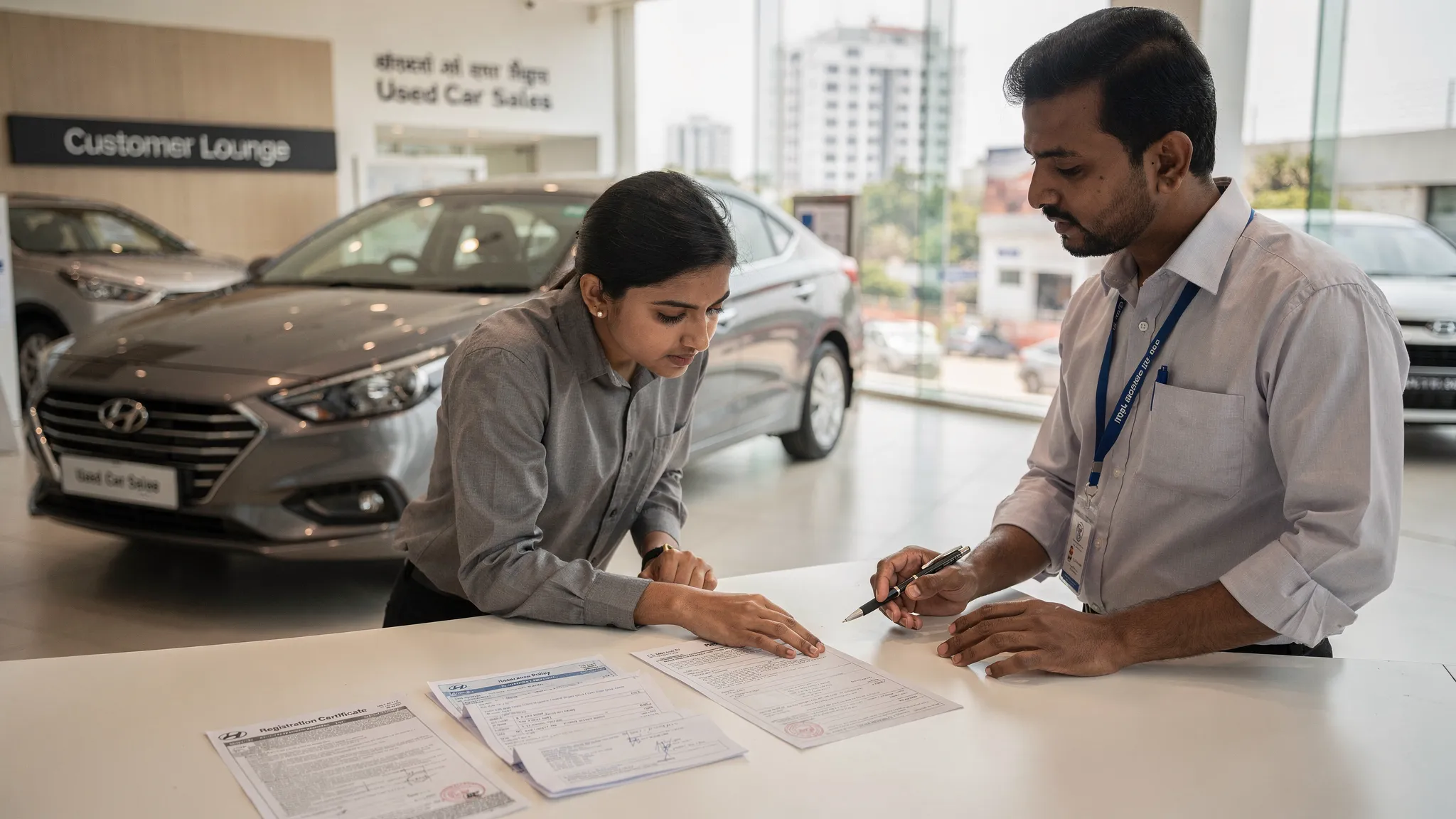
4) Ask for these documents and details before visiting
Request these on WhatsApp/email so you can review calmly. If a dealer refuses to share basics, treat it as a red flag.
RC (Registration Certificate) essentials
- Owner name and address (match with seller/dealer claim)
- Registration number and RTO
- Chassis number and engine number (you will later match these on the vehicle)
- Hypothecation (HP) status (important if the car was financed)
Insurance status
- Is the policy active?
- What is the expiry date?
- Any major claims (if the dealer can share, it helps you understand past repairs)
Service history (if available)
Service records can reveal recurring issues and odometer consistency. Even partial records help.
Loan closure proof (if hypothecation exists)
If the RC shows HP, ask what the plan is:
- Will the dealer provide NOC from the bank?
- Will Form 35 be handled for HP removal?
Challans and legal dues
Ask if there are pending e-challans. You can also verify independently on official portals.
For ownership and vehicle-related services, you can refer to India’s official transport services portal, Parivahan.
PUC validity
A valid PUC is part of compliance and may affect smooth insurance renewals and road checks. If you want a quick refresher on what PUC is and why it matters, see Hooter’s guide: PUC certificate explained.
5) Confirm the car’s basics on message (so you do not waste the trip)
Send the dealer a simple checklist and ask for clear answers:
- Exact variant (not just model name)
- Year and month of registration
- Odometer reading
- Number of owners
- Accident/repair disclosure (ask directly)
- Reason for sale (even if it is dealer stock, they should have a narrative)
- What is included in the price (insurance, transfer support, accessories)
This step alone filters out many problematic listings.
6) What to carry when visiting 2nd hand car dealers
Come prepared like you are closing the deal (even if you are not). It changes how seriously the dealer treats you.
- Driving licence (for the test drive)
- Aadhar/PAN (some dealers ask for ID proof for booking or paperwork)
- Your shortlist and benchmark prices (screenshots are fine)
- A flashlight (useful for underbody/engine bay quick checks)
- A friend who will stay objective (pressure situations are real)
If you are comfortable with basic checks, an inexpensive OBD scanner can help surface error codes, but do not treat it as a substitute for a professional inspection.
7) On-site checks that specifically protect you from dealership-style surprises
This is not a full “used car inspection checklist” (Hooter already has a detailed guide for that: The Ultimate Checklist for Buying a Used Car). These are the dealer-visit checks that prevent paperwork traps and sales tactics.
Match the car to the documents
- Verify the VIN/chassis number on the car matches RC details
- Confirm the engine number if accessible
- Check that the registration number matches plates and paperwork
Watch for common red flags inside the dealership process
| Red flag at the dealership | What it can indicate | What to do |
|---|---|---|
| “Price is valid only today” pressure | Artificial urgency to stop comparison | Leave, compare, come back if it is truly the best option |
| Refusal to share documents/copies | Paperwork gaps, unclear ownership | Do not pay any booking amount |
| Extra “handling/processing” charges added late | Inflated deal cost | Ask for an all-inclusive written quote |
| Odometer story keeps changing | Possible tampering or inconsistencies | Demand service history, walk away if unclear |
| Test drive restricted to a tiny loop | Hiding steering, suspension, braking issues | Insist on a route with bumps, turns, and moderate speeds |
Insist on a clean payment trail
If you pay a token/booking amount:
- Get a receipt with vehicle details (registration number, model, variant)
- Clarify if it is refundable and under what conditions
Avoid cash payments without documentation.
8) Plan your test drive like a verification exercise
A test drive is not just about comfort, it is where you catch costly issues early (alignment pull, brake vibration, gearbox hesitation, suspension noise).
For a structured approach, use Hooter’s detailed guide: Master Test Driving: Key Tips for Choosing Your Ideal Car.
Before you drive, decide what you will test:
- Cold start behaviour (if possible)
- Low-speed steering and suspension noise
- Brake feel and straight-line stability
- AC performance (important in Indian weather)
If the dealer says “another customer is waiting”, do not rush. Better to lose a questionable car than buy a problem.
9) Be clear about paperwork and transfer responsibility
Many disputes happen because buyers assume the dealer will “handle everything.” Before you proceed, confirm:
- Who submits the RC transfer and how long it will take
- What documents you will receive immediately (sale invoice, delivery note)
- How insurance will be handled (transfer vs fresh policy)
For official reference on vehicle services and status checks, use Parivahan.
10) Use price comparisons to negotiate with confidence
Negotiation is easier when it is not emotional.
A simple method:
- Compare the same model and variant across multiple listings
- Adjust your offer based on documented gaps (tyres, battery age, missing service history, cosmetic work)
- Negotiate on the total deal, not just the car price (especially if insurance and transfer are bundled)
If you want to reduce the legwork, using a platform that offers car price comparison and a broad set of listings can help you identify fair pricing before you visit.
Frequently Asked Questions
What should I ask a used car dealer before visiting? Ask for RC details (owner, HP status, chassis/engine number), insurance validity, service history (if available), challan status, exact variant, and an all-inclusive price quote.
How do I know if a 2nd hand car dealer is genuine? Look for consistent address and business details, transparent sharing of documents, clear pricing (no last-minute fees), and a willingness to allow a proper test drive and independent inspection.
Is it safe to pay a booking amount to a used car dealer? It can be, but only if you receive a written receipt with vehicle details and clear refund terms. Avoid cash without paperwork.
What documents should I carry to a used car dealership? Carry your driving licence for the test drive, and keep Aadhar/PAN handy in case you decide to book. Also carry your shortlist and price benchmarks.
Should I buy insurance from the dealer or outside? Compare both. Dealer-provided insurance can be convenient, but it is often priced higher. Always ask for insurer name, IDV, add-ons, and full premium breakup before agreeing.
When I search “2nd hand car dealers near me”, what is the biggest mistake to avoid? Visiting without verifying documents and pricing first. Always shortlist online, ask for RC and insurance details in advance, and get an all-inclusive quote before travelling.
Ready to shortlist verified used cars before visiting dealers?
Instead of visiting multiple lots blindly, start by browsing and comparing options online. With Hooter, you can explore a comprehensive used-car marketplace, check listings from verified dealers, and use price comparisons to understand what a fair deal looks like.
Explore listings at Hooter and go to the dealership with a shortlist, a plan, and stronger bargaining power.