
When you search “2nd hand cars near me”, you usually want two things at once: a car that is actually nearby, and a deal that is safe. In India, the second part matters just as much because odometer rollbacks, hidden accidents, pending loans, and incomplete paperwork can turn a “great price” into a long headache.
This guide gives you a practical, local-first process to find trustworthy 2nd hand cars near you, verify the seller, and close the purchase with the right checks.
Start with the right “near me” filters (so you do not waste weekends)
“Near me” should be specific, not random. Before you look at any listing, set clear boundaries:
- Distance and commute reality: Choose a radius you can comfortably revisit for a second inspection and test drive.
- Budget with transfer costs: Keep room for insurance, minor repairs, and RC transfer related expenses.
- Use-case fit: City commute, highway runs, family use, or first-time driver, your shortlist should match your driving pattern.
If you browse on an online marketplace, prefer platforms that make it easy to narrow by city, budget, body type, and brand, and that show enough details to compare options side-by-side.
Choose the safest seller type for your risk appetite
Not all “nearby” sellers carry the same risk. In general:
Verified dealers vs individual sellers
- Verified dealers (lower risk, often smoother paperwork): You can compare multiple cars in one place, and there is usually more accountability.
- Individual sellers (sometimes cheaper, higher diligence needed): You must be extra strict about documentation, condition checks, and payment safety.
On marketplaces like Hooter, you can focus on verified dealer listings, compare prices, and use expert guidance to reduce the chance of a bad buy.
Use a “trust score” mindset: 4 checks that matter more than a low price
A trustworthy used car is not just about good photos and a clean interior. Use these four pillars to evaluate any nearby option.
Seller credibility (identity, consistency, transparency)
Ask for basic details early. A genuine seller should be comfortable sharing:
- Owner name matching RC
- Clear reason for selling
- Service history availability (even partial)
- Time window for a proper daytime inspection
Red flag: Rushed sale lines like “first come first served, pay token now” before you have checked documents.
Paperwork integrity (RC, insurance, loan status)
In India, paperwork can reveal more than a 10-minute walkaround. You should verify:
- RC details: Owner name, registration number, chassis/engine number match
- Hypothecation status: Whether the vehicle has an active loan endorsement
- Insurance validity: Current policy details and claim history (as much as the insurer will share)
- PUC validity: Required for legal compliance
You can cross-check registration details using official MoRTH services via Parivahan. (Exact available data can vary by state and service.)
Mechanical and accident reality (inspection beyond the surface)
Even honest sellers may not know the full condition. Your goal is to spot expensive issues early:
- Uneven panel gaps, repaint signs, overspray, underbody scrapes
- Tyre wear pattern (alignment and suspension clues)
- AC performance, overheating signs, warning lights
- Suspension noises over speed breakers
If you are not confident, pay for a mechanic inspection. It is usually far cheaper than post-purchase repairs.
Price fairness (compare locally, not emotionally)
A “great deal” should survive comparison. Always compare:
- Same model, variant, and year
- Similar mileage band
- Same city (local demand changes pricing)
Hooter’s car price comparison can help you sanity-check whether a nearby listing is priced like the market, or priced like a trap.
The local inspection workflow that catches most bad cars
Do the evaluation in two rounds: quick screening, then detailed checks.
Round 1: Quick screening (15 minutes)
Aim to eliminate obvious misfits fast.
- Match registration number, VIN/chassis stamping, and RC
- Start the car cold (avoid cars warmed up before you arrive)
- Check for smoke, rough idle, warning lights
- Short drive with basic braking and steering feel
If it passes, move to Round 2.
Round 2: Detailed checks (45 to 60 minutes)
Use a proper test-drive plan. For a deeper test-drive framework, refer to Hooter’s guide: Master Test Driving: Key Tips for Choosing Your Ideal Car.
During this round, focus on:
- Straight-line tracking: car should not pull left or right on a flat road
- Braking: no steering shake, no squeal, consistent pedal feel
- Gearbox behavior: smooth shifts (manual or automatic), no jerks or delays
- Ride quality: listen for knocks from suspension
- Electronics: windows, lights, infotainment, camera/sensors
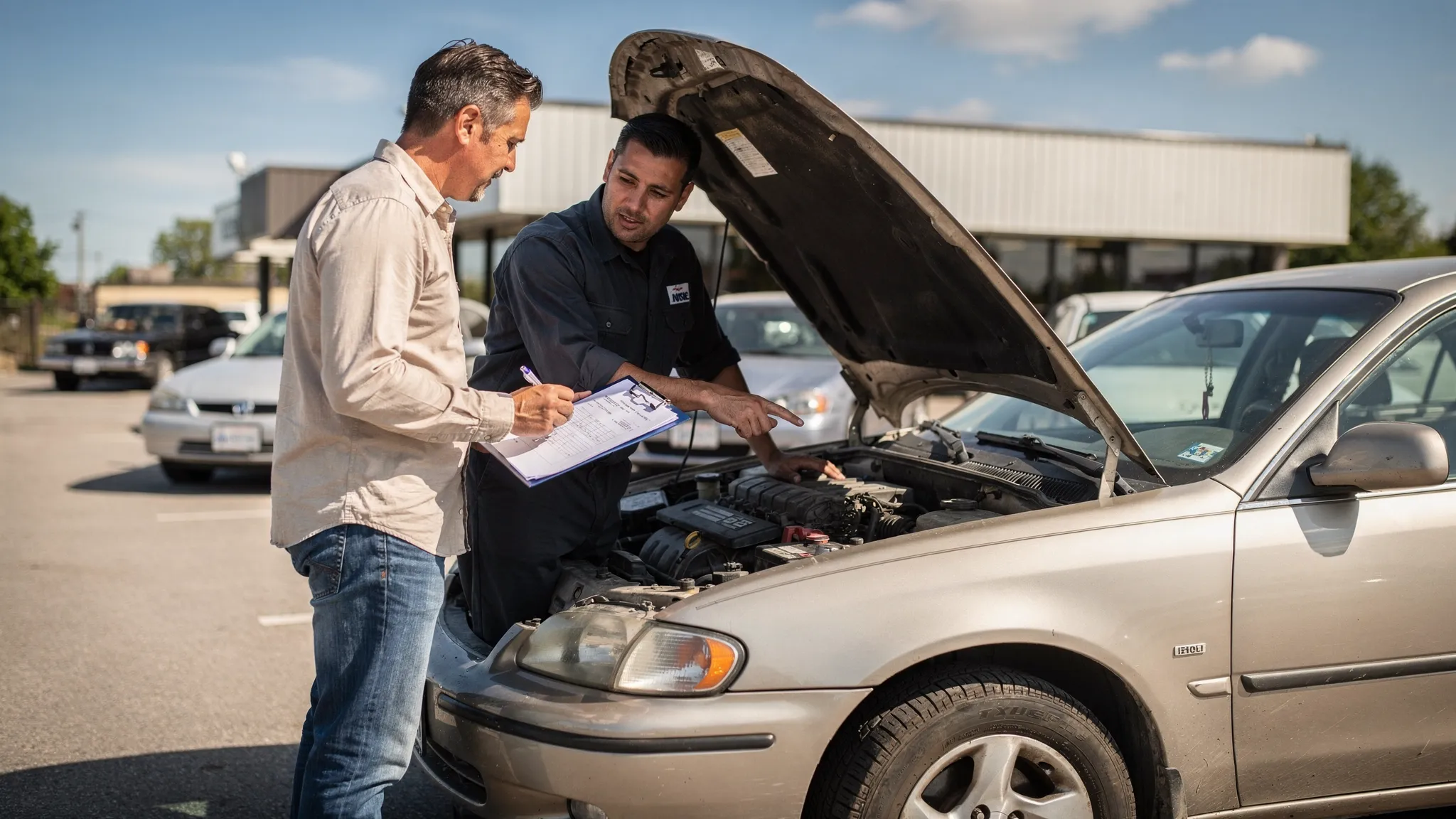
Documents checklist for buying a used car in India (near-me purchases)
Paperwork is where most “cheap” cars become risky. Use this table as your non-negotiable checklist.
| Document or detail | What to check | Why it matters |
|---|---|---|
| RC (Registration Certificate) | Owner name, address, vehicle class, engine/chassis numbers | Confirms legal ownership and identity of the vehicle |
| Insurance | Validity, type (third-party/comprehensive), any major claim indicators | Affects immediate legal compliance and future premium |
| PUC certificate | Validity date | Driving without valid PUC can attract penalties and issues during checks |
| Service history / invoices | Regularity, major part replacements, last service date | Helps validate mileage and maintenance quality |
| Hypothecation (if any) | Loan closed proof, hypothecation removal process | Pending loan can block transfer and create legal risk |
| Pending challans / dues | Check status where possible | Unpaid dues can become a transfer complication |
| Form 29/30 (transfer forms) | Correct names, signatures, dates | Core documents for ownership transfer process |
If you want a more comprehensive end-to-end list (including negotiation and delivery-day checks), use: The Ultimate Checklist for Buying a Used Car.
Common scams around “2nd hand cars near me” and how to avoid them
Scams tend to spike when buyers are in a hurry or shopping from unknown sources.
Odometer rollback
Clues include worn pedals/steering on a “low mileage” car, inconsistent service records, and unusually cheap pricing for the claimed km.
Token amount pressure
Avoid paying a “booking token” before you:
- Verify documents
- Inspect the car in daylight
- Confirm refund terms in writing
RC transfer delays
A seller who says “transfer later” is a risk. Treat ownership transfer as part of the deal, not an afterthought.
Fake or mismatched documents
Always match chassis/engine numbers on the vehicle with RC details. If anything does not match, walk away.
How to close the deal safely (payment, delivery, transfer)
A trustworthy purchase ends with a clean, documented closing.
Payment hygiene
- Prefer traceable payments and proper receipts.
- Avoid sharing OTPs, UPI PINs, or screenshots that expose sensitive info.
Delivery-day final checks
Do a last walkaround and confirm:
- Both keys (if applicable)
- All documents promised
- Tyres and spare wheel condition
- Basic fluids and warning lights
Ownership transfer
Use the proper RTO process for your state. Official details and services are available via Parivahan. If you are unsure, get help from a trusted dealer or a professional service to avoid errors.
Why an online marketplace can be safer than random local listings
Local WhatsApp forwards and unverified classifieds can work, but they shift all risk to you. A structured marketplace helps because you can:
- Discover multiple nearby options without travelling blindly
- Compare prices faster n- Prefer listings from verified dealers
- Get expert insights to shortlist the right model for your needs
That is exactly the type of experience Hooter aims to provide as a comprehensive marketplace for verified used cars.
Frequently Asked Questions
How do I find trustworthy 2nd hand cars near me quickly? Shortlist using tight location and budget filters, then prioritise verified dealers, inspect in daylight, and verify RC, insurance, PUC, and loan status before any payment.
What is the biggest red flag when buying a used car locally? Pressure tactics, especially “pay token now” or “no time for inspection,” and reluctance to share documents upfront.
Can I check vehicle details online in India before buying? Yes. You can use official MoRTH tools through the Parivahan portal to cross-check registration-related details (availability varies by service and state).
Is a test drive enough to confirm a used car is good? No. A test drive is essential, but it should be combined with document verification and a mechanical inspection, especially for higher-mileage cars.
Find verified 2nd hand cars near you on Hooter
If you are ready to shop smarter, explore Hooter to discover and compare used cars from verified dealers near your location, with transparent listings and expert guidance to help you buy with confidence.