
Buying a used car in Delhi can be a smart financial decision, especially if you want a practical vehicle for office commutes, family errands, school runs, or regular Delhi to Gurugram travel. But the same market that gives you plenty of choice can also be confusing. Similar cars can have very different prices, paperwork can be incomplete, and vehicles used in Delhi traffic may hide clutch, suspension, AC, or accident-related issues.
The good news is that you can buy 2nd hand cars in Delhi with confidence if you follow a structured process. Instead of depending only on a dealer’s word or a low price, focus on three things: verified listings, document checks, and a proper physical inspection.
This guide is built specifically for Delhi and Delhi NCR buyers, including people living or working around Dwarka, Rohini, South Delhi, West Delhi, Noida border areas, and Gurugram. Use it before you shortlist, test drive, negotiate, or make payment.
Why buying a 2nd hand car in Delhi needs extra care
Delhi is a demanding city for cars. Heavy traffic, long idling hours, summer heat, dust, tight parking spaces, monsoon waterlogging, and daily runs between Delhi and Gurugram can all affect a vehicle differently from what the odometer shows.
A car with only moderate kilometres may still have high wear if it spent years in bumper-to-bumper traffic. Similarly, a diesel car may look like a bargain, but Delhi NCR’s age-related restrictions can reduce its practical usable life.
For Delhi NCR buyers, these local factors matter:
- Diesel vehicles older than 10 years and petrol vehicles older than 15 years are restricted in Delhi NCR, so the registration year is as important as the car’s condition.
- Cars used for daily Gurugram or NH48 commutes may have more highway wear, tyre wear, and suspension stress.
- Delhi’s summer heat makes AC performance a serious inspection point, not a comfort extra.
- Monsoon waterlogging in some areas increases the risk of flood-damaged cars entering the used market.
- Parking damage, repainted panels, and bumper repairs are common in dense residential areas.
Step 1: Fix your budget according to Delhi usage
Before you start comparing listings, decide what the car must do for you. A car that is perfect for South Delhi office runs may not be ideal for a daily Delhi to Gurugram commute. Similarly, a compact hatchback may be easier to park in crowded colonies, while a compact SUV may feel more comfortable on broken patches and flyovers.
Your budget should include more than the selling price. Keep money aside for immediate service, tyres, insurance transfer or renewal, RC transfer charges, FASTag update, parking accessories, and small repairs that are common in used cars.
| Delhi NCR use case | Suitable used car type | What to prioritise |
|---|---|---|
| Daily city driving in Delhi | Hatchback or compact sedan | Mileage, AC, clutch health, compact size |
| Delhi to Gurugram commute | Sedan, compact SUV, efficient hatchback | Highway stability, tyres, brakes, fuel economy |
| Family use | Compact SUV, sedan, MPV | Rear-seat comfort, boot space, safety features |
| First car for city learning | Small hatchback | Easy parking, low repair cost, clear visibility |
| Premium upgrade | Sedan or SUV | Service history, insurance claims, electronics check |
A common mistake is spending the full budget on the car and leaving nothing for post-purchase work. Even a well-maintained 2nd hand car may need a fluid change, alignment, new wipers, detailing, or minor dent repairs after delivery.
Step 2: Start with verified listings, not random leads
Delhi has everything from organised dealers to individual sellers and informal brokers. The safest approach is to shortlist online first, compare prices, and visit only the cars that pass your basic checks.
On Hooter, Delhi NCR buyers can explore verified dealer listings, compare car prices, browse by budget or body type, and use expert insights to make a more informed decision. This is especially useful if you do not want to visit multiple dealers across Delhi and Gurugram without knowing whether the car, price, or seller is worth your time.
When shortlisting, compare cars with the same make, model, variant, fuel type, registration year, kilometres, ownership count, and transmission. A 2019 petrol manual and a 2019 diesel automatic may belong to the same model family, but their value, maintenance, and usable life in Delhi NCR can be very different.
Step 3: Check Delhi NCR registration and age rules first
Before you fall in love with a car, check the registration year and fuel type. This is one of the most important Delhi-specific checks.
If a diesel car is already 8 or 9 years old, it may have limited usable life in Delhi NCR even if it is mechanically strong. If a petrol car is 13 or 14 years old, it may be cheap, but you need to think carefully about resale and long-term use.
Also check whether the car is registered in Delhi, Gurugram, or another state. A DL registration can be simpler for a Delhi buyer, while an HR26 Gurugram registration may still work well if the paperwork is clean. For cars registered outside Delhi NCR, confirm whether an NOC, re-registration, or additional process is required before you pay any token amount.
Use official platforms wherever possible. You can verify vehicle registration details through Parivahan and check pending challans through the official eChallan portal. These checks take only a few minutes and can save you from buying a car with hidden liabilities.
Step 4: Verify every document before negotiation
Documents are not a formality. They decide whether the car can legally become yours without future stress. In Delhi, where cars often change hands through dealers, brokers, companies, or family transfers, document mismatch is a common risk.
Ask for clear copies before visiting the car. If the seller hesitates to share basic details like RC, insurance, or service history, treat it as a warning sign.
| Document or detail | What to check | Why it matters in Delhi NCR |
|---|---|---|
| RC details | Owner name, registration date, fuel type, chassis number, engine number | Confirms identity, age, and legal usability |
| Insurance | Active policy, IDV, claim history if available | Reveals accident repairs and renewal cost |
| PUC certificate | Valid Pollution Under Control certificate | Required for legal driving and insurance renewal |
| Service history | Authorised or trusted workshop records | Helps verify maintenance and odometer consistency |
| Hypothecation status | Loan marked on RC or removed with NOC | Prevents loan-related ownership issues |
| Challans | Pending traffic fines | Buyer should not inherit unpaid penalties |
| CNG endorsement | CNG kit mentioned on RC, if applicable | Unendorsed CNG kits can create legal and safety issues |
If you are relocating to Delhi from abroad or managing travel paperwork at the same time, it can be useful to separate tasks clearly. Services that simplify travel paperwork can help with border-crossing administration, but car ownership checks in Delhi still need local verification through the seller, dealer, and transport records.
Step 5: Inspect the car like a Delhi buyer, not just a general buyer
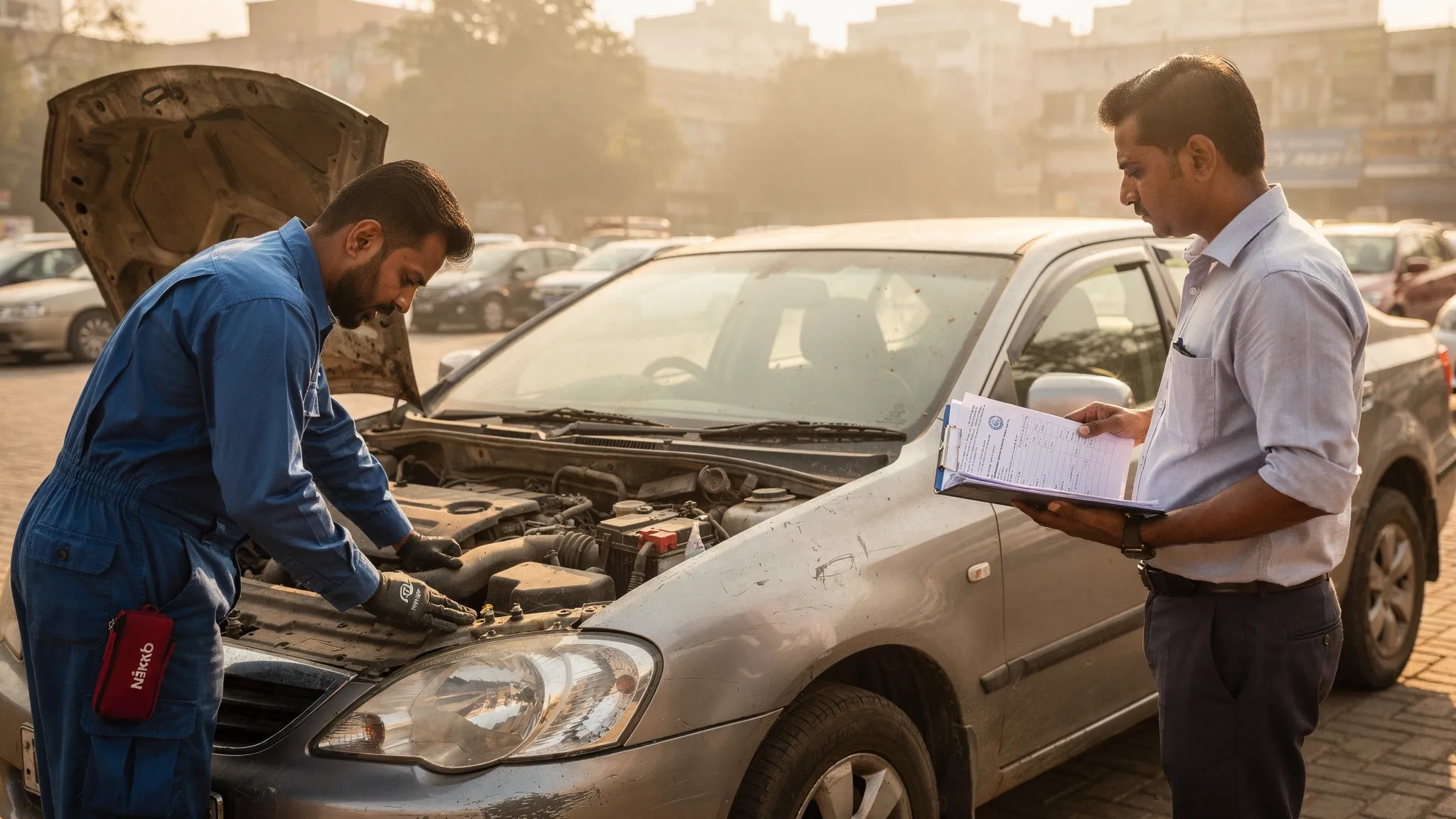
A shiny exterior can hide expensive problems. Always inspect the car in daylight, preferably when the engine is cold. If the seller has already warmed up the engine before you arrive, ask why. A cold start can reveal battery weakness, smoke, engine noise, or starting trouble.
For Delhi-used cars, pay special attention to these areas:
- AC cooling at idle and in traffic-like conditions, because Delhi summers are harsh.
- Clutch bite point in manual cars, especially if the car has done heavy city driving.
- Automatic gearbox shifts at low speed, including jerks or delays in bumper-to-bumper movement.
- Suspension noise over speed breakers, broken roads, and parking ramps.
- Underbody rust or water marks, especially if the car came from a waterlogging-prone area.
- Tyre condition, uneven wear, and manufacturing date.
- Repaint signs around doors, bonnet, boot, pillars, and bumpers.
- Interior wear compared with odometer reading, including steering, pedals, seat bolsters, and gear knob.
A professional pre-purchase inspection is strongly recommended, especially for cars above ₹5 lakh, automatic cars, diesel cars, premium cars, or vehicles with missing service records. Paying for an inspection is much cheaper than discovering engine, gearbox, or accident damage after purchase.
Step 6: Take a test drive that matches your real route
A short drive around the dealer’s lane is not enough. Your test drive should recreate how you will actually use the car in Delhi NCR.
Start with slow-speed driving to check clutch, steering, brakes, and engine response. Then try a slightly open stretch where you can check stability, gear shifts, braking, and cabin noise. If you regularly drive between Delhi and Gurugram, the car should feel stable at legal highway speeds and comfortable in stop-go traffic.
During the test drive, do not play loud music. Listen for rattles, suspension thuds, brake squeal, wheel bearing noise, and dashboard vibrations. Test the AC, power windows, infotainment, reverse camera, parking sensors, central locking, headlights, indicators, wipers, and horn.
After the test drive, park the car and check for fluid leaks under the engine bay. Also look at the temperature gauge and warning lights. Any warning light that stays on should be diagnosed before negotiation, not after payment.
Step 7: Compare the price with Delhi market reality
Used car prices in Delhi can vary widely because of registration year, fuel type, variant, condition, ownership history, and remaining legal life. Do not compare only by model name.
For example, two used sedans from the same year may have different values if one has a full service history, new tyres, and no insurance claims, while the other has repainting, pending challans, and an expiring insurance policy. Similarly, an older diesel SUV may look attractive, but the 10-year Delhi NCR restriction should be reflected in the price.
When negotiating, use facts rather than pressure. Point out upcoming expenses like tyres, battery, insurance renewal, service due, brake work, repainting, RC transfer, or pending challans. A genuine seller or dealer will usually discuss these points transparently.
Dealer, individual seller, or online marketplace?
There is no single perfect source. The right choice depends on your experience, time, and risk tolerance.
| Buying source | Best for | Main advantage | Main caution |
|---|---|---|---|
| Verified dealer listing | Buyers who want structure and support | Easier comparison, documentation support, more options | Still inspect and verify documents |
| Individual seller | Experienced buyers | Possible direct negotiation | More paperwork and fraud risk |
| Local car market | Buyers who can inspect multiple cars | Many options in one area | Quality and transparency can vary |
| Online marketplace | Busy Delhi NCR buyers | Shortlist by budget, brand, body type, and location | Visit only after basic verification |
For most first-time used car buyers in Delhi, starting online and then visiting shortlisted cars is the most efficient route. It reduces random visits and helps you compare options before facing sales pressure.
Step 8: Make payment safely and complete transfer properly
Never pay a large token amount before seeing the car, verifying documents, and confirming the seller’s identity. If you do pay a small booking amount, take a written receipt that mentions the car details, amount, date, refund terms, and seller details.
For final payment, use traceable banking channels. Avoid paying the full amount in cash. The sale agreement should clearly mention the buyer, seller, vehicle details, agreed price, payment mode, delivery date, and responsibility for RC transfer, insurance transfer, pending challans, and loan closure if applicable.
After payment, do not delay transfer. RC transfer and insurance transfer are essential to avoid legal and financial complications. Also update FASTag, remove the previous owner’s connected car access if applicable, and keep copies of all forms, receipts, and acknowledgements.
Red flags to avoid when buying 2nd hand cars in Delhi
Walk away if something feels wrong. Delhi’s used car market has many genuine sellers, but it also has cars with hidden accident history, tampered odometers, pending loans, unpaid challans, or incomplete ownership records.
Be careful if the seller refuses inspection, avoids sharing the RC, pushes you to pay immediately, offers a price far below market value, or says paperwork will be handled “later”. Also be cautious if the car is shown at a random location with no clear seller identity.
Other warning signs include mismatched paint on structural areas, uneven panel gaps, damp carpets, musty cabin smell, missing airbags, non-functional warning lights, duplicate keys unavailable, and service records that do not match the odometer.
A simple confidence checklist before you say yes
Before you finalise any 2nd hand car in Delhi, confirm these points:
- The car’s age is suitable for Delhi NCR rules.
- RC, insurance, PUC, and service records are available.
- Chassis and engine numbers match the RC.
- No major pending challans are visible.
- Loan hypothecation is removed or supported by proper NOC.
- A mechanic or inspection expert has checked the car.
- Test drive results are satisfactory in city and open-road conditions.
- Final price reflects condition, tyres, insurance, service, and remaining usable life.
- Payment is traceable and supported by written receipts.
- RC and insurance transfer responsibility is clearly agreed.
If even two or three of these points are unclear, pause the deal. Another car will always be available, but reversing a bad used car purchase can be difficult.
Frequently Asked Questions
Is it safe to buy 2nd hand cars in Delhi online? Yes, if you use a trusted platform, verify documents, inspect the car physically, take a proper test drive, and make payment through traceable channels. Online shortlisting is useful, but final checks should never be skipped.
Should I buy a diesel used car in Delhi? You can consider it only if the vehicle has enough remaining usable life under Delhi NCR’s 10-year diesel rule and the price reflects that limitation. For long-term city use, many buyers prefer petrol, CNG, hybrid, or EV options.
What documents are most important when buying a used car in Delhi? RC, insurance, PUC, service history, challan status, hypothecation removal proof, seller ID, and transfer forms are key. For CNG cars, the CNG kit should be endorsed on the RC.
How much should I keep aside after buying a used car? Keep a separate amount for immediate service, insurance, tyres, battery, detailing, RC transfer, and small repairs. The exact amount depends on the car’s age, condition, and segment.
Can I buy a Gurugram-registered car if I live in Delhi? Yes, but check the registration details, age limit, insurance, challans, and transfer requirements carefully. If you will drive regularly in Delhi NCR, the car must remain compliant with local restrictions.
Buy your next 2nd hand car in Delhi with more confidence
The safest way to buy a used car is to compare first, inspect carefully, verify documents, and avoid rushing into payment. A low price is useful only when the car is legally clean, mechanically sound, and suitable for Delhi NCR usage.
If you are ready to shortlist options, explore verified used car listings, compare prices, and get expert guidance on Hooter. Whether you are buying in Delhi or commuting daily between Delhi and Gurugram, Hooter helps you make a more transparent and confident used car decision.